Neural Network Methods for Permeability Prediction in Carbonate Reservoirs
Unlocking Subsurface Secrets with AI
Neural Network Permeability Prediction Carbonate reservoirs, while holding a significant portion of the world’s hydrocarbon reserves, are notoriously complex. Their extreme heterogeneity, stemming from diverse depositional environments and extensive diagenetic alterations, makes accurate permeability prediction a persistent challenge. Permeability, the measure of a rock’s ability to transmit fluids, is a critical parameter for effective reservoir characterization, production forecasting, and optimizing hydrocarbon recovery strategies. Traditional methods often struggle to capture the intricate pore systems of carbonates, leading to significant uncertainties.
However, the advent of Artificial Intelligence (AI) and, more specifically, Neural Network Permeability Prediction methods, is revolutionizing how we approach this challenge. By leveraging the power of machine learning, geoscientists and reservoir engineers can now build more robust and accurate models, transforming our understanding of fluid flow in these complex formations.
The Power of Neural Networks in Petrophysics
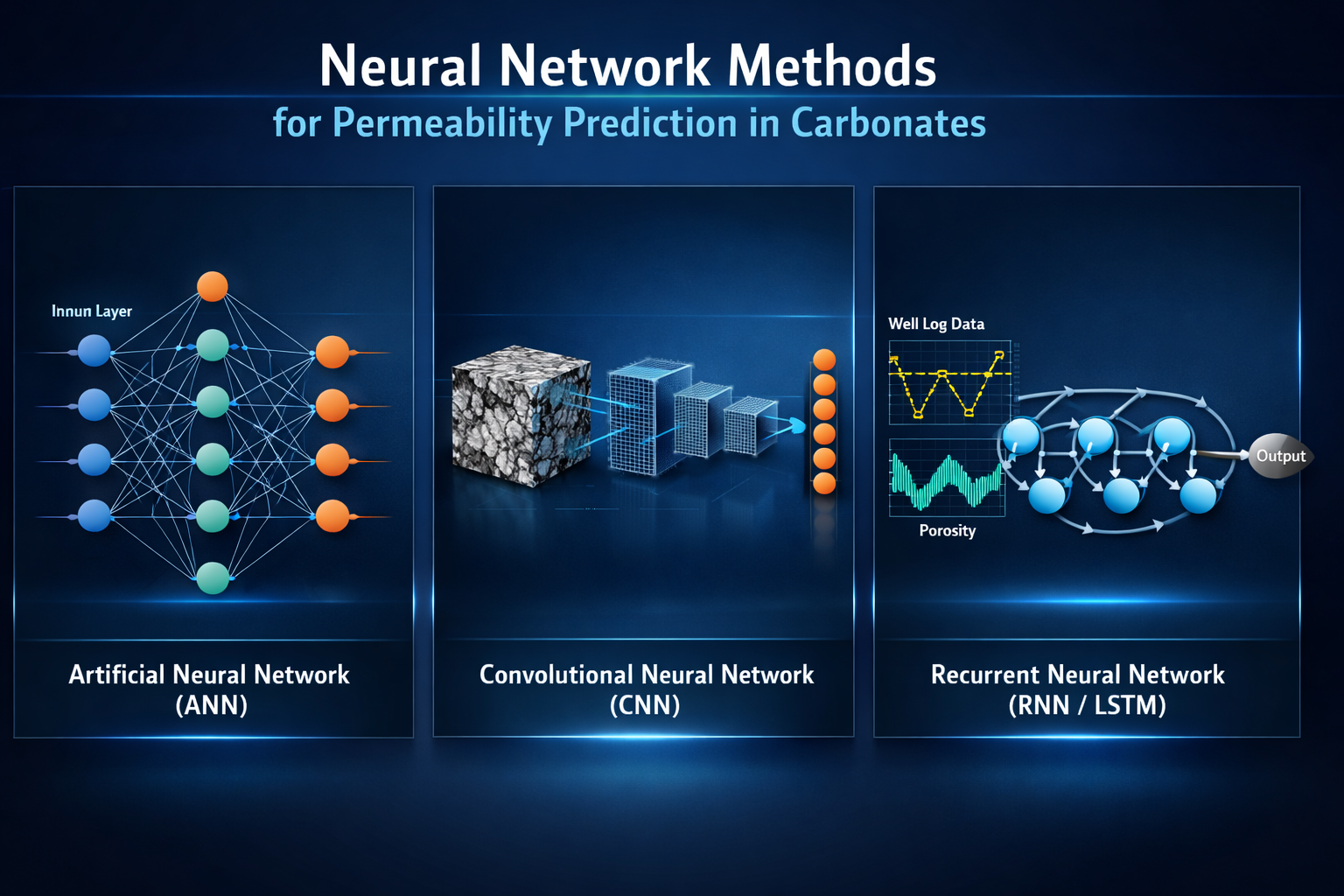
Neural networks are a subset of machine learning inspired by the human brain’s structure and function. They are particularly adept at identifying complex, non-linear patterns within large datasets, making them ideal for petrophysical applications where relationships between various rock properties and permeability are often intricate and difficult to model with conventional techniques. The image below illustrates three primary types of neural networks commonly employed in this field:
1. Artificial Neural Networks (ANN)
Artificial Neural Networks (ANNs), often referred to as Multi-Layer Perceptrons (MLPs), are foundational to many AI applications. In the context of Neural Network Permeability Prediction, ANNs are used to establish complex relationships between input parameters (such as porosity, irreducible water saturation, clay content, and even seismic attributes) and permeability. They are particularly effective when dealing with structured data from core analysis and well logs. ANNs can learn intricate correlations that might be overlooked by linear regression models, providing a more nuanced prediction of permeability across a reservoir [1].
2. Convolutional Neural Networks (CNN)
Convolutional Neural Networks (CNNs) have emerged as a game-changer in image recognition and processing. Their architecture is specifically designed to process data with a known grid-like topology, such as images. For Neural Network Permeability Prediction, CNNs are invaluable for analyzing digital rock images obtained from micro-CT scans or petrographic thin sections. By applying convolutional filters, CNNs can automatically extract intricate pore-scale features, such as pore size distribution, connectivity, and tortuosity, which are crucial for understanding fluid flow pathways. This allows for a direct link between the rock’s microstructure and its hydraulic properties, moving beyond traditional empirical correlations [2].
3. Recurrent Neural Networks (RNN) and Long Short-Term Memory (LSTM)
Recurrent Neural Networks (RNNs), including their more advanced variant, Long Short-Term Memory (LSTM) networks, are designed to process sequential data. This makes them exceptionally well-suited for analyzing well log data, which is inherently sequential along the depth of a wellbore. RNNs can capture temporal (or depth-wise) dependencies and trends, allowing them to learn how petrophysical properties evolve with depth and how these changes impact permeability. For instance, an LSTM can effectively model the influence of adjacent rock layers on the permeability of a given interval, leading to more accurate predictions in heterogeneous formations [3].
The Future of Permeability Prediction
The integration of these diverse neural network methods represents a significant leap forward in Neural Network Permeability Prediction. By combining the strengths of ANNs for general data correlation, CNNs for pore-scale imaging, and RNNs for sequential log analysis, geoscientists can develop comprehensive, multi-scale models that capture the full complexity of carbonate reservoirs. This leads to:
- Enhanced Accuracy: More precise permeability estimates, reducing uncertainty in reservoir models.
- Improved Efficiency: Faster analysis of large datasets and digital rock volumes.
- Optimized Decisions: Better-informed choices for drilling, completion, and production strategies.
As AI technology continues to evolve, we can expect even more sophisticated neural network architectures and hybrid models to emerge, further refining our ability to unlock the subsurface secrets of carbonate reservoirs. The synergy between geoscience and artificial intelligence is paving the way for a new era of reservoir characterization.
References
[1] Al-Khdheeawi, E. A., et al. (2023). A New Approach to Predicting Vertical Permeability for Carbonate Reservoirs. https://www.mdpi.com/2075-163X/13/12/1519
[2] Tang, P., et al. (2022). Predicting permeability from 3D rock images based on convolutional neural networks with physical information. https://www.sciencedirect.com/science/article/pii/S0022169422000488
[3] Mohammadian, E., et al. (2022). A case study of petrophysical rock typing and permeability prediction using machine learning in a heterogenous carbonate reservoir in Iran. https://www.nature.com/articles/s41598-022-08575-5
Internal Links (Placeholders)