Advanced Carbonate Petrophysics: Unlocking the Secrets of Complex Reservoirs
The Carbonate Conundrum: Why Petrophysics is Challenging
Carbonate Petrophysics are critical to global energy supply, holding over 60% of the world’s oil and gas reserves. However, their inherent complexity makes accurate petrophysical characterization a formidable challenge. Unlike clastic rocks, carbonates are formed through biological and chemical processes, leading to extreme heterogeneity in pore systems. This heterogeneity is further complicated by extensive diagenetic alterations—processes like cementation, dissolution, and dolomitization—that occur after deposition. These factors result in a wide spectrum of pore types, from microscopic interparticle pores to large vugs and complex fracture networks, all of which significantly impact fluid flow and reservoir performance.
Accurate Carbonate Petrophysics is therefore paramount for effective reservoir modeling, reliable reserve estimation, and optimizing hydrocarbon recovery strategies. Without a deep understanding of these intricate pore systems, reservoir simulations can be highly uncertain, leading to suboptimal drilling and production decisions.
An Integrated Approach to Carbonate Petrophysics
To overcome these challenges, modern Carbonate Petrophysics relies on an integrated, multi-scale approach that combines cutting-edge laboratory techniques with advanced computational and data-driven methods. This holistic strategy aims to bridge the gap between microscopic pore-scale observations and macroscopic reservoir-scale predictions, providing a more comprehensive and accurate understanding of fluid flow.
Below, we illustrate the key pillars of this integrated approach:
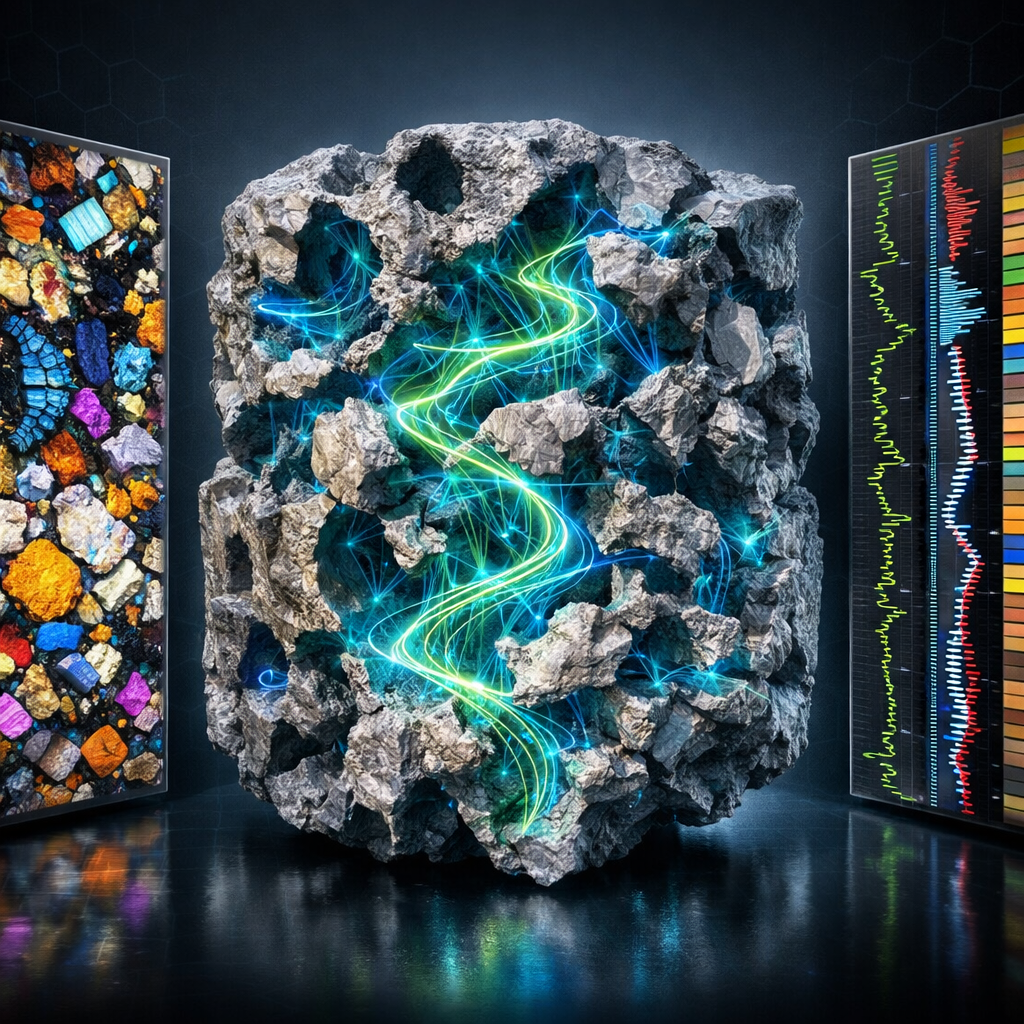
1. Microscopic Insights: Thin Section Petrography
The foundation of advanced Carbonate Petrophysics begins with detailed petrographic analysis. High-resolution thin sections, often enhanced with specialized stains or blue-dyed epoxy, provide invaluable insights into the rock’s fabric, mineralogy, and pore types at the grain scale. This microscopic examination allows geoscientists to:
•Identify primary and secondary porosity types (e.g., interparticle, intraparticle, moldic, vuggy, fracture).
•Understand diagenetic history and its impact on pore evolution.
•Quantify pore geometry, connectivity, and distribution.
This qualitative and quantitative characterization is crucial for building realistic pore network models and interpreting macroscopic measurements, providing the ground truth for understanding reservoir quality .
2. Digital Rock Physics: 3D Pore Network Modeling
Building upon petrographic insights, Digital Rock Physics (DRP) has revolutionized Carbonate Petrophysics. This involves reconstructing the complex 3D pore geometry from micro-CT scans or digital images of rock samples. Once reconstructed, advanced algorithms are used to simulate fluid flow, electrical conductivity, and other petrophysical properties directly within the digital rock model. DRP allows us to:
•Visualize fluid pathways and connectivity in 3D.
•Quantify effective permeability and formation factor.
•Assess the impact of different pore types on fluid flow.
•Perform sensitivity analyses on various petrophysical parameters.
This provides a direct, non-destructive link between the rock’s microstructure and its hydraulic properties, offering a powerful predictive tool that complements traditional laboratory measurements .
3. Integrated Well Log Analysis and Rock Typing
At the reservoir scale, advanced well log analysis is indispensable for Carbonate Petrophysics. Modern logging tools provide a wealth of data, including Gamma Ray, Density, Neutron, Sonic, Resistivity, and Nuclear Magnetic Resonance (NMR) logs. Integrating these logs allows for:
•Accurate porosity and fluid saturation determination.
•Identification of different lithofacies and rock types.
•Estimation of permeability using empirical models or machine learning algorithms.
Crucially, Rock Typing methodologies (e.g., hydraulic flow units, electrofacies) are applied to segment the reservoir into zones with similar petrophysical characteristics. This helps to manage the inherent heterogeneity of carbonates, ensuring that permeability and other properties are assigned appropriately across the reservoir model .
The Future of Carbonate Petrophysics
The synergy between microscopic analysis, digital rock physics, and integrated well log interpretation is transforming Carbonate Petrophysics. This multi-faceted approach leads to:
•Enhanced Accuracy: More precise characterization of pore systems and fluid flow.
•Reduced Uncertainty: Improved confidence in reservoir models and production forecasts.
•Optimized Development: Better-informed decisions for well placement, completion design, and enhanced oil recovery (EOR) strategies.
As technology continues to advance, we can expect even more sophisticated integration of AI, machine learning, and advanced imaging techniques to further refine our understanding of these vital, yet challenging, carbonate reservoirs. The future of Carbonate Petrophysics is bright, promising more efficient and sustainable resource development.
References
[1] Skalinski, M. (2016). Examination of Petrophysical Characteristics of Carbonate Reservoirs.
Internal Links (Placeholders)
•Understanding Reservoir Heterogeneity