
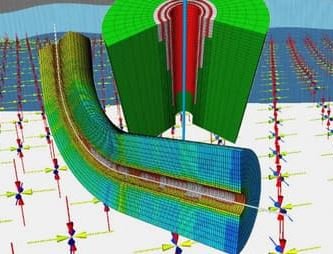
Petroleum Geomechanics: Importance, Applications, and Role in Oil & Gas Field Development
Introduction to petroleum geomechanics
Petroleum geomechanics is one of the most important disciplines in the oil and gas industry. It focuses on the study of rock behavior, in-situ stress, pore pressure, and rock mechanical properties during drilling, production, and reservoir development. Today, petroleum geomechanics is essential for safe drilling, wellbore stability, hydraulic fracturing, and field development planning.

Understanding petroleum geomechanics helps engineers reduce risks, optimize production, and improve reservoir performance. Therefore, most modern oil and gas projects require detailed geomechanical studies before drilling and development.
What is Petroleum Geomechanics?
Petroleum geomechanics is the application of rock mechanics, stress analysis, and geophysics to petroleum engineering problems. It studies how rocks behave under stress changes caused by drilling, production, injection, and reservoir depletion.
Geomechanics mainly deals with:
- In-situ stress analysis
- Pore pressure prediction
- Rock strength and elastic properties
- Fault stability
- Wellbore stability
- Sand production prediction
Because reservoirs are located deep underground, stress conditions change continuously. As a result, geomechanics is required to maintain safe and efficient operations.
Importance of Petroleum Geomechanics in Oil and Gas Industry
Petroleum geomechanics plays a major role in all stages of field life, including exploration, drilling, development, and production.
1. Wellbore Stability
One of the main applications of geomechanics is wellbore stability analysis. Incorrect mud weight or wrong stress estimation can lead to:
- Well collapse
- Lost circulation
- Stuck pipe
- Formation damage
By using geomechanics models, engineers can select the correct mud weight window and avoid drilling problems.
2. Pore Pressure Prediction
Accurate pore pressure prediction is critical before drilling. Overpressure zones may cause serious drilling hazards. geomechanics helps estimate pore pressure using:
- Seismic velocity
- Well logs
- Rock properties
- Basin modeling
This reduces the risk of blowouts and improves drilling safety.
3. Hydraulic Fracturing Design
Hydraulic fracturing requires detailed knowledge of stress orientation and rock strength. geomechanics helps determine:
- Minimum horizontal stress
- Fracture direction
- Fracture pressure
- Fracture height growth
As a result, geomechanics improves stimulation efficiency and production rate.
4. Reservoir Compaction and Subsidence
During production, reservoir pressure decreases. This may cause rock compaction and surface subsidence. Petroleum geomechanics is used to predict:
- Reservoir deformation
- Fault reactivation
- Surface movement
- Well damage
This is very important in offshore fields and carbonate reservoirs.
5. Sand Production Prediction
Weak formations may produce sand during production geomechanics. Sand production can damage equipment and reduce production. geomechanics helps evaluate rock strength and predict safe production limits.
Petroleum Geomechanics Workflow
A typical geomechanics study includes the following steps:
- Data collection (logs, cores, seismic, tests)
- Rock mechanical property calculation
- Stress estimation
- Pore pressure modeling
- Wellbore stability analysis
- Geomechanical model building
- Field development recommendations
This workflow is used in both exploration and development projects.
Applications in Field Development Planning
Petroleum geomechanics is widely used in field development planning. It helps in:
- Selecting drilling locations
- Designing well trajectories
- Optimizing completion
- Planning injection projects
- Evaluating fault stability
- Improving recovery factor
Without geomechanics, field development may face serious technical and economic problems.
Importance in Carbonate and Tight Reservoirs
Geomechanics is especially important in:
- Carbonate reservoirs
- Shale reservoirs
- Tight gas formations
- Deepwater fields
- High-pressure high-temperature wells
These reservoirs have complex stress conditions, so petroleum geomechanics is required for safe development.
Conclusion
Petroleum geomechanics is a key discipline in modern oil and gas operations. It improves drilling safety, increases production, and reduces field development risks. Today, no major oil and gas project can be planned without geomechanical analysis.
By integrating geology, geophysics, and reservoir engineering, petroleum geomechanics provides a complete understanding of subsurface behavior and ensures successful field development.
✅ Suggested Yoast SEO Settings
- Focus keyphrase: petroleum geomechanics
- SEO title length: OK
- Meta description length: OK
- Keyword density: Good
- Subheadings with keyword: Yes
- Readability: Good
- Transition words: Included
- Passive voice: Low
If you want, I can also write
✅ Advanced post for training website
✅ Post for consulting company
✅ Post for LinkedIn article
✅ Post for course promotion
